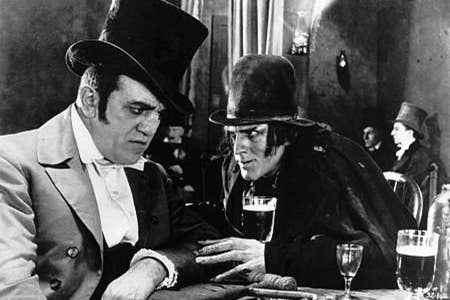
Dr. Jekyll and Mr. Hyde (1920)
At a Glance
-
Length
c. 70 minutes
About this Piece
It’s not the most important fact about the film, but it’s perhaps the most bizarrely pertinent to experiencing Dr. Jekyll and Mr. Hyde inside a classical concert hall: Edgard Varèse, the French American composer, appears in this 1920 silent film playing not one but two small roles. Varèse had moved to New York in 1915 and was friendly with several artists, including the painter Marcel Duchamp. Still, it’s unclear how exactly in the fall of 1919 he found his way into the Amsterdam Opera House, which the Famous-Lasky Film Service had just converted into a movie studio and where the future “father of electronic music,” then 35, filmed scenes as both a London policeman and a jilted Italian who poisons his wife’s lover in a flashback. They are brief moments in the film, but there’s no mistaking Varèse’s handsomely dark profile.
Strange Case of Dr Jekyll and Mr Hyde, Robert Louis Stevenson’s gothic novella, was published in 1886 (three years after Varèse was born), and it has fascinated actors and filmmakers ever since. This study of human duality, of the dark fiend and better angel that live inside us all, has an elemental appeal as well as a moral one; for an actor, it’s two parts for the price of one, a chance to play intellectual saint and greasy sinner. John Barrymore, born in 1882, may have become an actor reluctantly—he first tried being a painter—but the profession was too strongly in his blood: His parents were both famous stage thespians, and his brother (Lionel) and sister (Ethel) became famous screen actors. Barrymore debuted on the Chicago stage in 1903, and he soon distinguished himself as one of America’s finest Shakespeare interpreters. He joined Adolph Zukor’s Famous Players Film Company in 1913 and was the leading man in several comedies, playing caddish drinkers and young husbands. His first dramatic role came in 1919, playing a wronged convict, but the plum double role of Jekyll and Hyde was his richest prospect yet.
Barrymore’s performance is the film’s roaring furnace. The man who would come to be dubbed “The Great Profile” used his prominent nose and wise face in careful poise as the good doctor, a man so virtuous that he runs a “human repair shop” for the poor and has won the heart of the innocent Millicent Carew—so virtuous, in fact, that his colleagues debate whether a man can really be that good and set about tempting him into vice. Jekyll rebuffs the sexy dancer Gina, but she successfully wakens him “to a sense of his baser nature,” and he locks himself inside his laboratory to produce a potion that lets him divide his two natures. As Hyde, Barrymore adopted an entirely different facial persona, fiendish and pervy, with a more hunched, animalistic physicality.
“There seems to be no end to Mr. Barrymore’s capabilities,” Variety raved in April 1920. “One could easily stamp him the most sterling actor of today.” The experience was so intense for the actor, compounded by the fact that he was simultaneously playing Richard III onstage, that he suffered a nervous breakdown. “But it is his responsive susceptibilities on which producers can play as though they were drawing beautiful music from the strings of highly tuned instruments which have enabled him to materially elevate screen acting,” said Picturegoer in 1921.
The screenplay by Clara S. Beranger, who became a prolific scribe for Famous Players-Lasky (progenitor of Paramount Pictures) and an original faculty member at USC’s film school, took liberties with Stevenson’s tale, inventing Millicent from whole cloth. Playing the ingenue was Martha Mansfield, real name Martha Erlich, whose acting career was cut tragically short just three years later when her period Southern costume caught fire on a Texas filming location. She died from her injuries, only 23.
Dr. Jekyll and Mr. Hyde premiered March 28, 1920, at the Rivoli, breaking attendance records at the Broadway theater. Dr. Hugo Reisenfeld, an Austrian violinist who became one of New York’s eminent silent-film conductors, prepared accompaniment music for the house orchestra: The overture was taken from Verdi’s La forza del destino and the score compiled from other classical sources. Tonight, the music is furnished entirely by Clark Wilson, silent-film organist extraordinaire and a Halloween staple at Walt Disney Concert Hall.
“The score utilizes a bit of everything,” Wilson explains—“tangos, old English themes, and general mood music and ‘scenics.’ It’s designed to follow the roller coaster of emotions that the picture offers, and restates a particular motif again and again in stronger patterns as we reach the climax. There’s even a phrase or two of Bach in the vampire-like scene.” Wilson fondly recalls accompanying Dr. Jekyll for the first time at the Hall, 20 years ago, when Drew Barrymore snuck in incognito to see her grandfather’s work, “something she had not experienced before. I later received a very nice note from her about the evening opening her eyes more to the silent-film art and how much she enjoyed the music.”
— Tim Greiving
Upcoming Events