Listening to The Great Wall of Los Angeles
Explore this hour-long symphonic tribute to the Angelenos who have shaped this city’s history

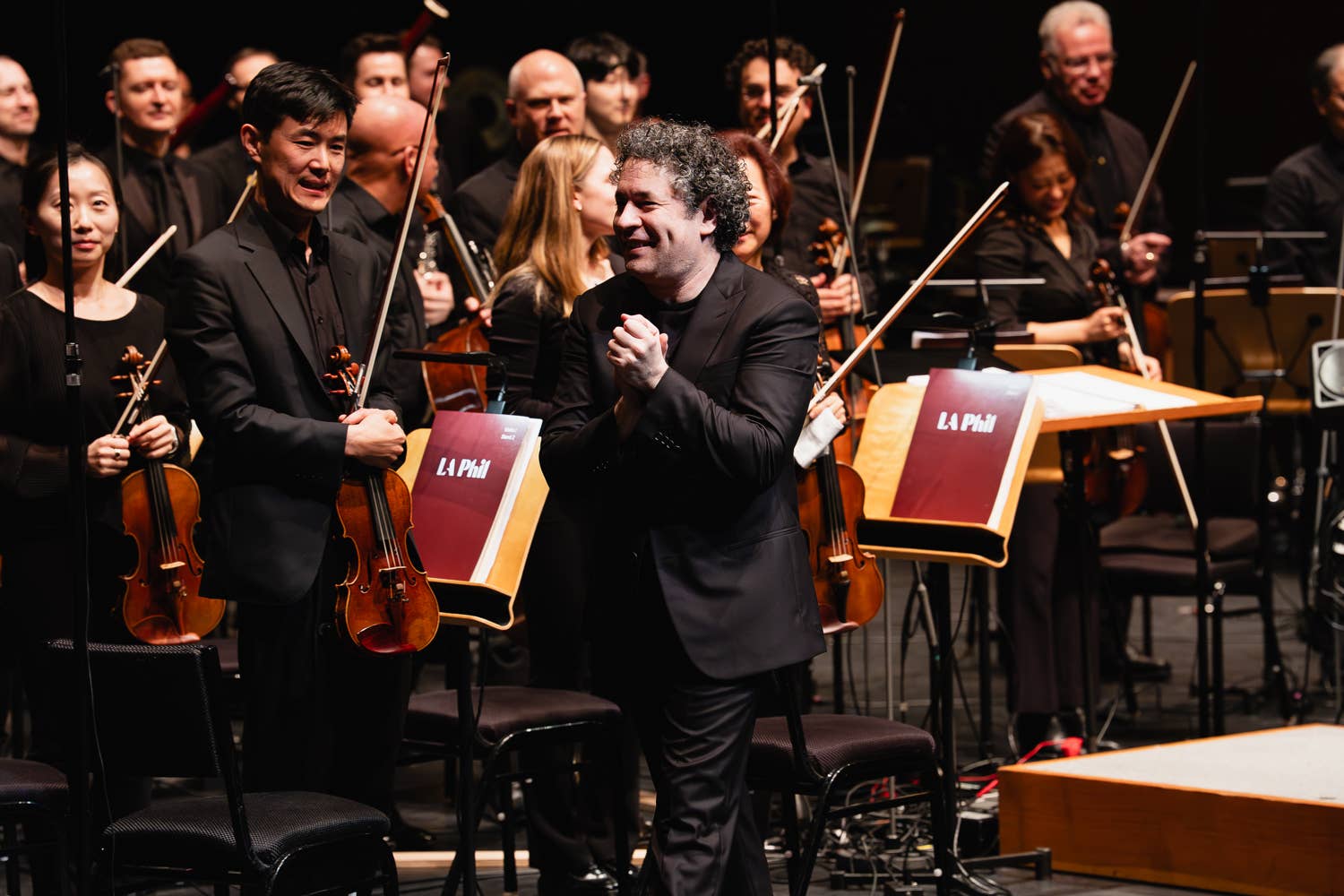
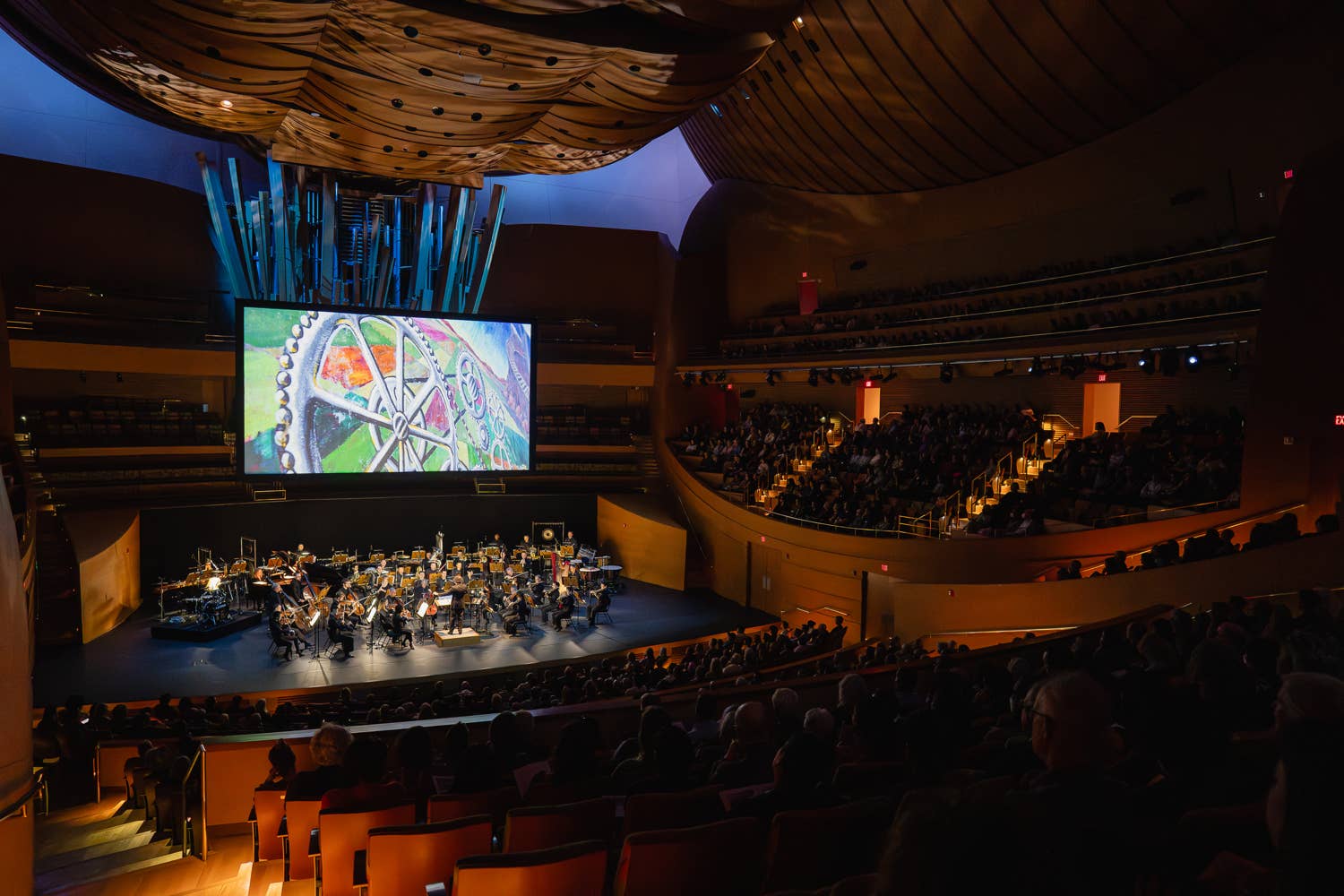
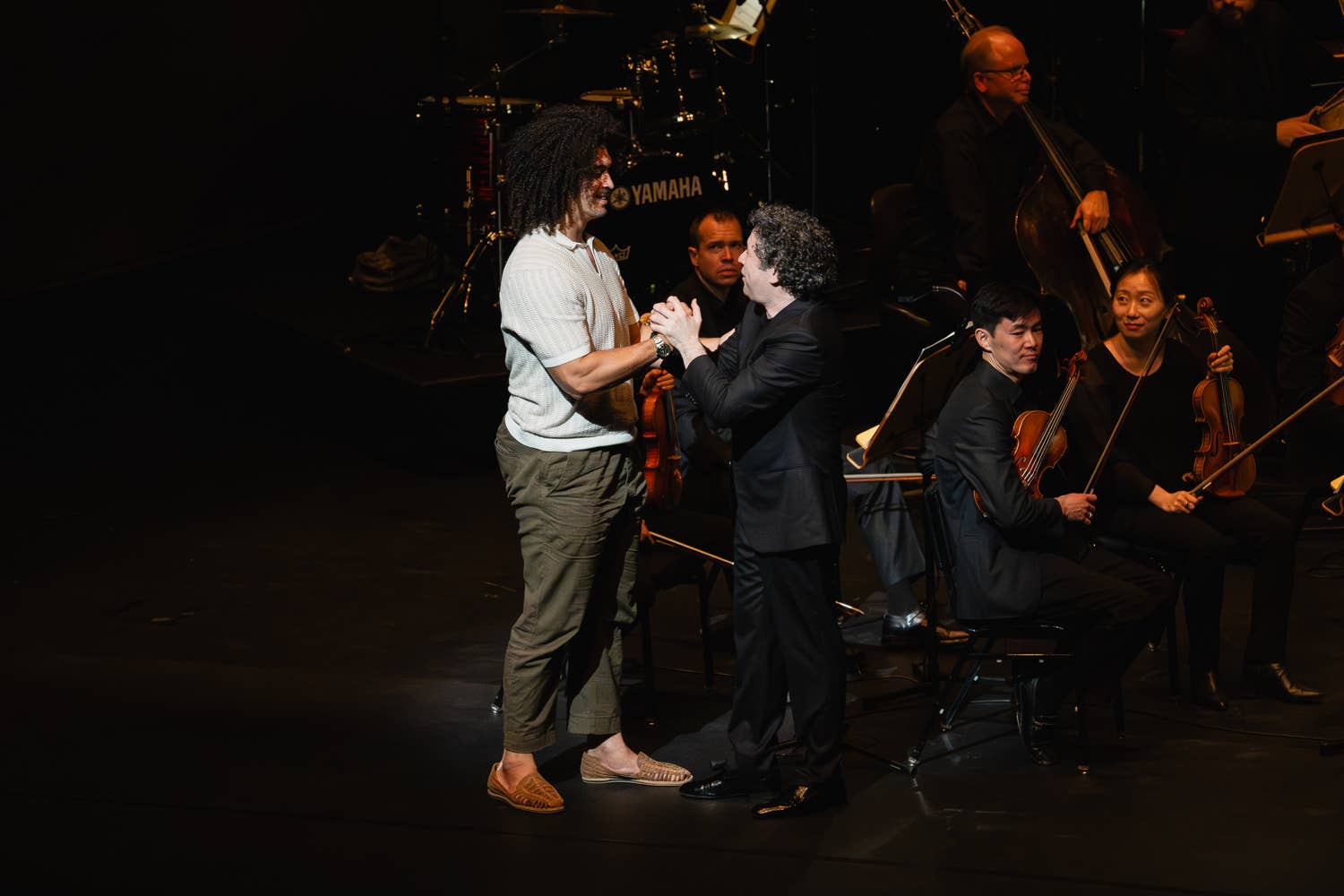
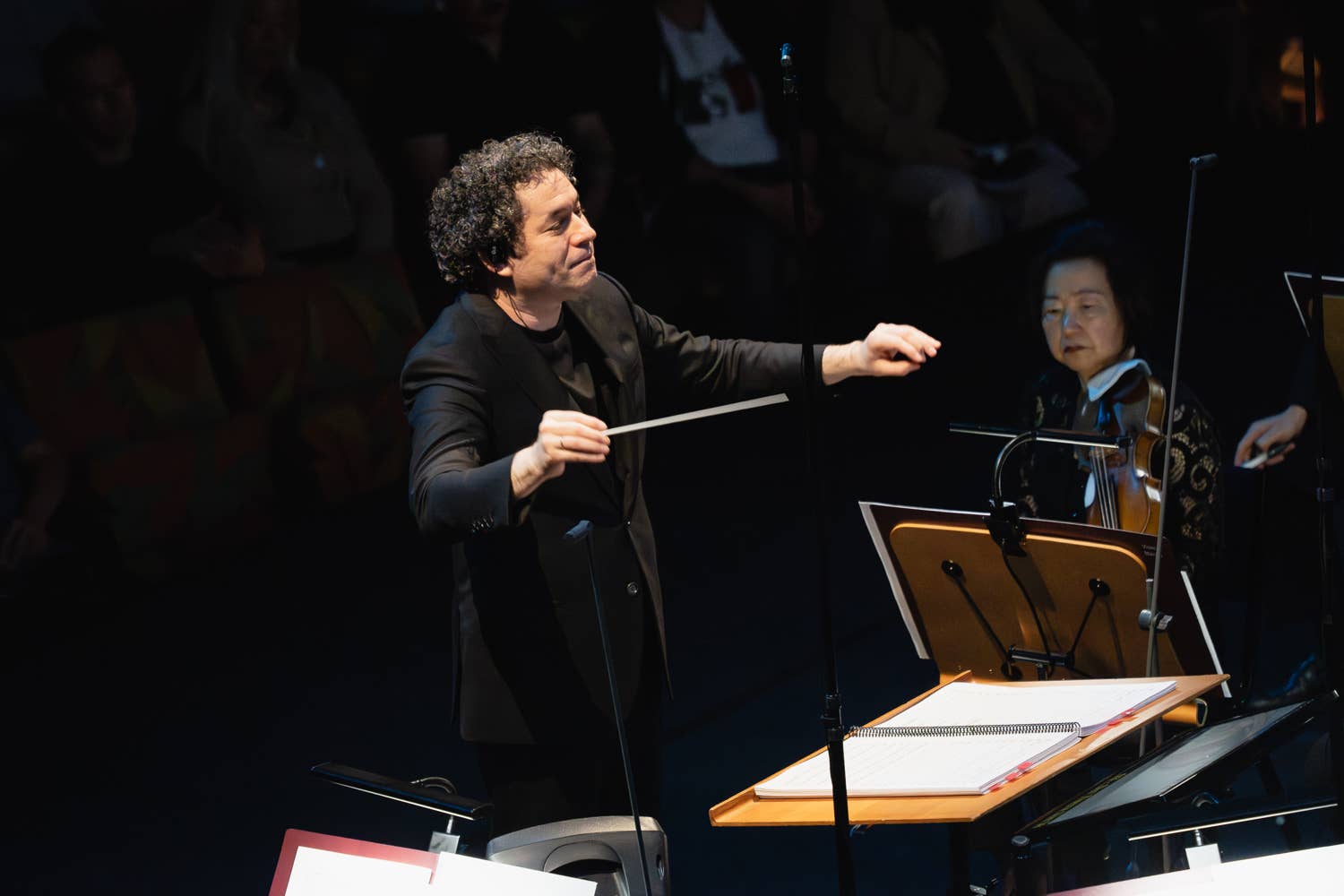
Inspired by Judy Baca’s mural The Great Wall of Los Angeles, Gustavo Dudamel and Gabriela Ortiz brought together a group of composers—Juhi Bansal, Nicolás Lell Benavides, Viet Cuong, Estevan Olmos, Xavier Muzik, and Nina Shekhar—featuring a video installation from Academy Award winners, director Alejandro G. Iñárritu and cinematographer Emmanuel “Chivo” Lubezki. The Great Wall of Los Angeles concert was performed by the LA Phil and conducted by Gustavo Dudamel at Walt Disney Concert Hall on March 7, 2026.

When you look at the wall, your wall, The Great Wall of Los Angeles, do you hear it?
Yes.
Is it noisy?
It can be.


When Judy Baca was growing up in Watts in the 1950s, she would walk to church with her grandmother. On some Sundays, she carried a wooden stick with her, which she dragged along the white picket fences of the homes they passed. The sound of the stick running across the fences—plucks, knocks, smacks, thuds—would change depending on how hard she pushed, how fast or slow she walked, and how much space there was between each fence post. The fences became instruments she played; she improvised scores by adjusting tempo and manipulating tone. It was her earliest memory of a key revelation: The landscape and the built environment were not just for looking. They were waiting to be listened to as well. They had their own music ready to be awakened.

Over 20 years later, when she began work on The Great Wall of Los Angeles in the Tujunga wash, she would replicate her childhood ritual. Looking down at the very first sections of the wall, she would walk along the upper edge of the concrete flood control channel and drag a stick along the chain link fence that separated her from the river below. The sounds from the fence would mix with sounds that were already there—wind in the cottonwoods, the trickle of water, the whir of street traffic—and it gave Baca an idea about The Great Wall that was taking shape below. “I thought to myself, we need a soundtrack for this,” Baca recalls. “We need voices and music to go alongside this imagery.”
Baca is a visual artist, or as she likes to call herself, a “political landscape painter.” But she’s always been a listener to the political landscapes she paints. “The land has memory,” she once wrote. “I have been learning to put my ear to the ground to listen and to understand the spirit of place.” Her murals are not silent: “a mural sings gospel from our streets.”1
Gallery
9 Images
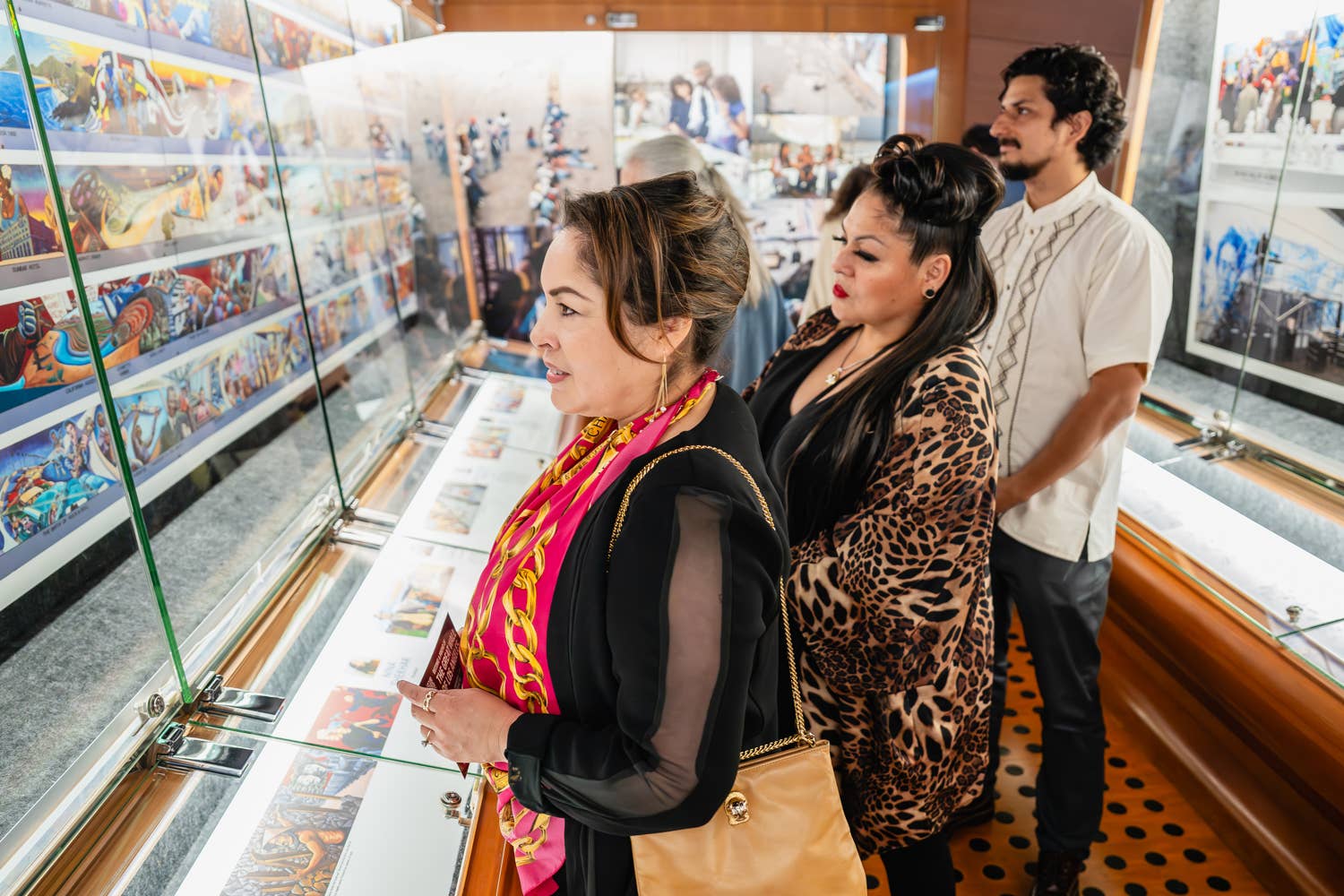
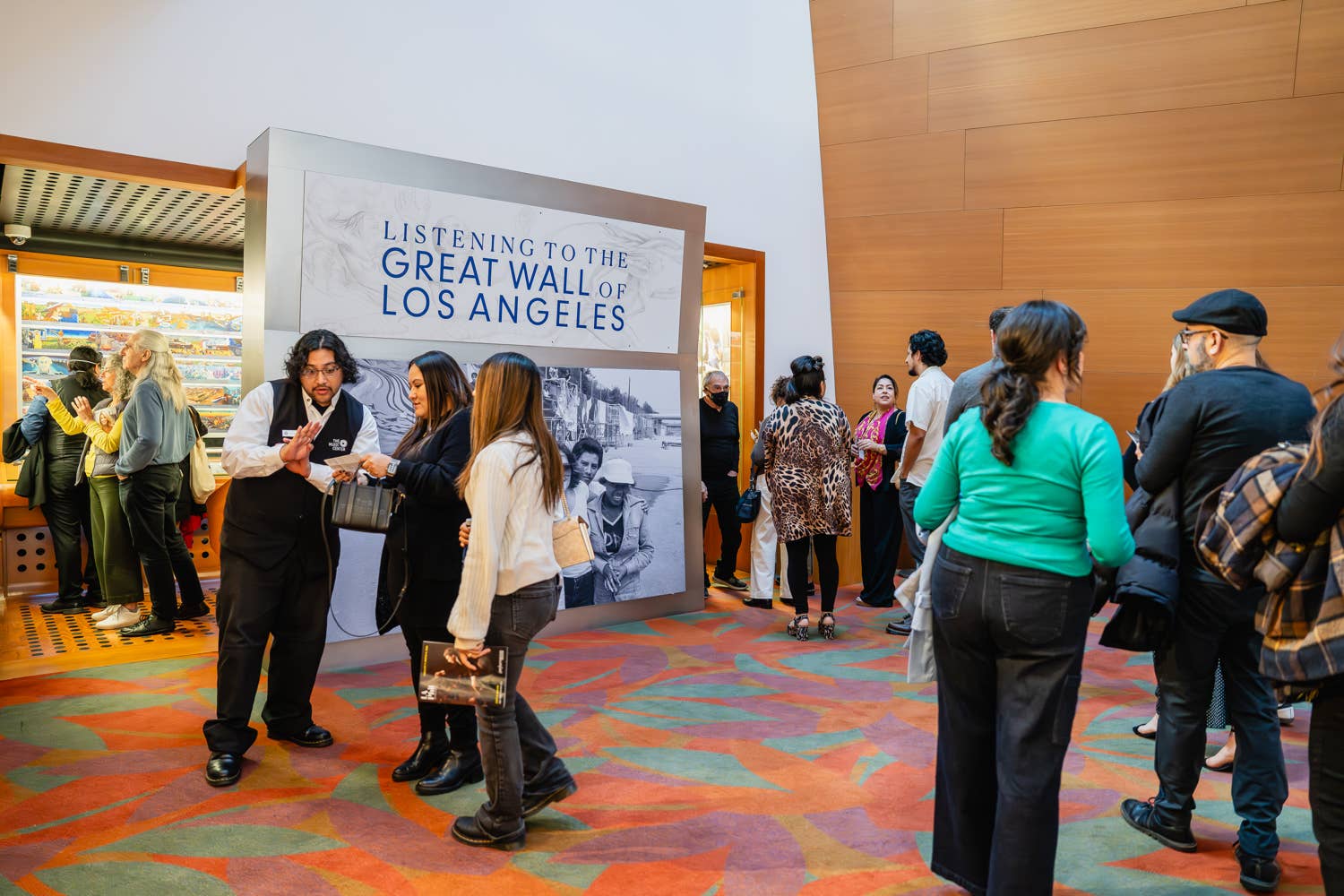
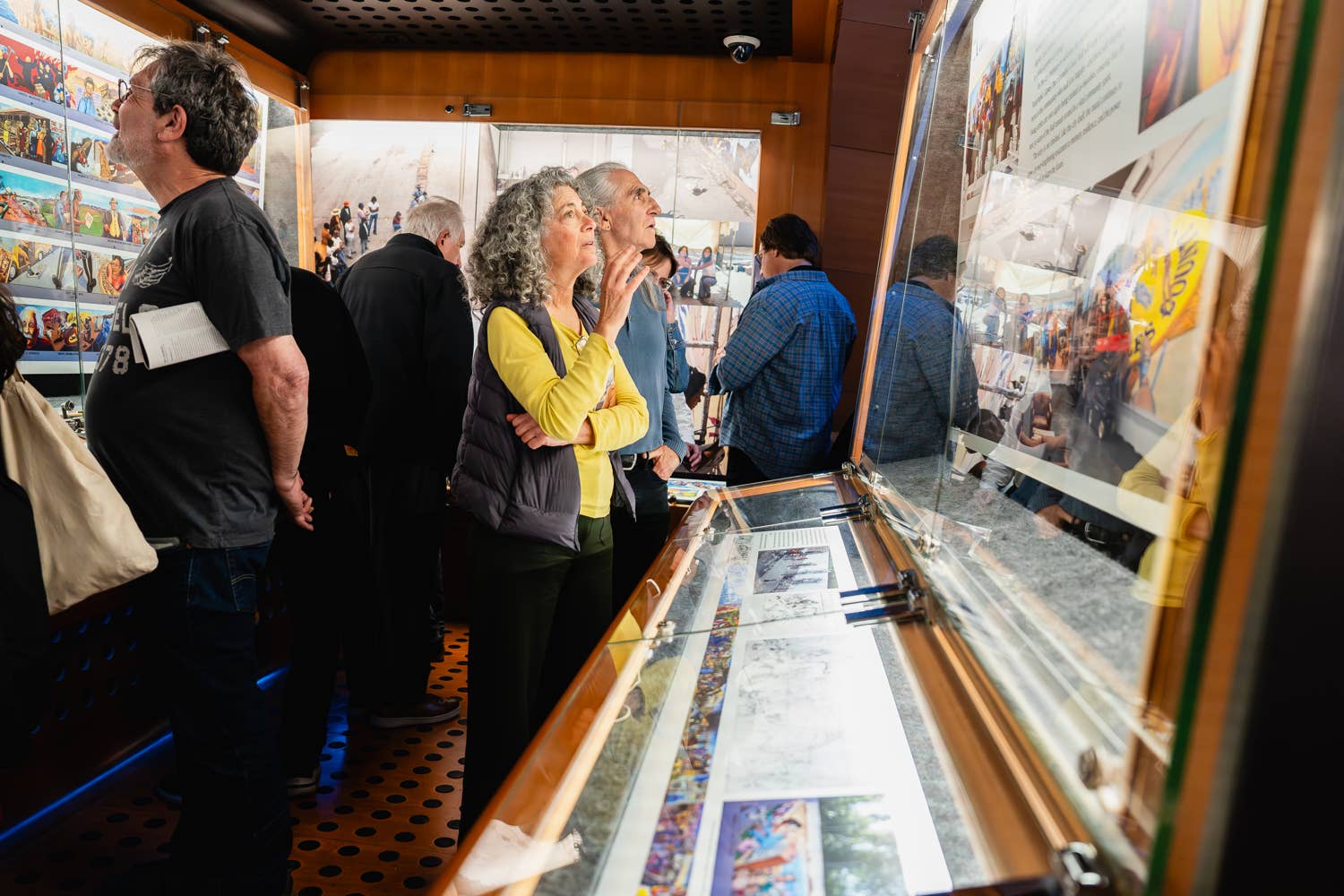
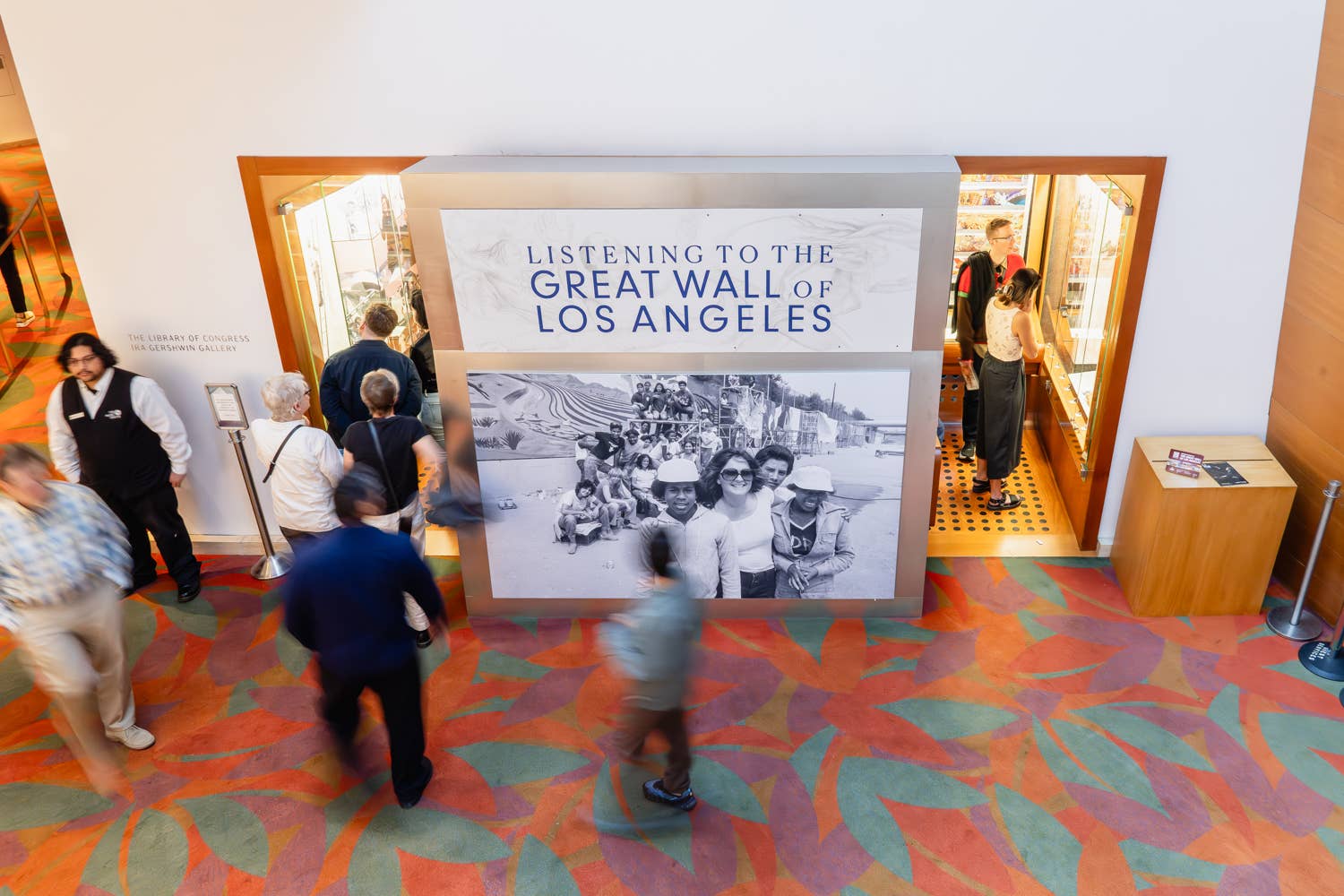


In Agnes Varda’s 1981 documentary about the murals of Los Angeles, Mur Murs, in which Baca and The Great Wall feature prominently, the filmmaker described murals as “talking, wailing, murmuring walls.” In one segment, Varda overlays a slow pan of The Great Wall’s panels with John Charles Fiddy’s “Prelude and Phew,” a jaunty slice of Baroque synth-pop that has no obvious connection to Los Angeles. But what are the actual murmurs of The Great Wall? What music does it hold? What gospel does it sing? Baca often fantasized about the wall as an interactive, multisensorial experience, with speakers blasting songs linked to specific panels. She even once staged a mini wall concert and invited a Mono Indian singer to sing tribal songs in the wash in front of the mural.
Baca grew up in a musical family. Her aunt sang rancheras. Her uncle was a jazz man, a saxophone player. He worked in a factory by day and played at clubs on Central Avenue by night. The two would rehearse in the one-bedroom Watts duplex apartment where Baca grew up, near 83rd and Central. Baca’s mother took the red car to Hollywood to compete in dance contests at the Palladium. “Everybody was musical,” Baca says. “I don’t know where I came from, a visual artist in the middle of a musical family.”
There is plenty of music in both the original half-mile stretch of The Great Wall of Los Angeles that already exists on the walls of the concrete river channel and in the mural’s newest panels currently in development in Baca’s studio in Bergamot Station Arts Center. There’s Billie Holiday singing at the Dunbar Hotel. There’s Elvis Presley and Chuck Berry, mid-song with guitars in hand, at a drive-in lined with palm trees. There’s Charlie Parker blowing on his alto and Big Mama Thornton in her blazer and cowboy hat about to belt “Hound Dog.” Joan Baez sings at a free speech rally. Jimi Hendrix and Janis Joplin perform in a psychedelic swirl at Woodstock. Marvin Gaye asks “What’s Going On” as refugees board boats to flee the war in Vietnam. And in one of the new panels, there is Nina Simone at the piano shouting “Mississippi Goddam,” the song’s score morphing into Black fists and upside down American flags.
Of all the musicians in The Great Wall, Simone was the only one who actually saw it. She was a friend of Guillermina Cantú Roland, who had photographed the mural, and the two turned up at Baca’s birthday party where Baca showed Simone images of the wall in her archive. As Simone was leaving she told Baca she wanted to be in the mural, but didn’t know exactly how. “I told her, ‘Singing the song, Mississippi Goddam,’” Baca recalls. “Nina pointed at me and said, ‘That's it!’”

Beyond the musicians pictured in The Great Wall of Los Angeles, Baca's process of painting itself has ties to musical composition. At a 1977 mural workshop at La Tallera of David Alfaro Siqueiros in Cuernavaca, Mexico she learned about the Punto System, a schematic approach to mapping visual imagery through lines and points of connection across space. “It’s almost like a musical notation and then I’m dropping images into it,” Baca explains. “Everything is based on rhythm, so that underneath the images there are these ratios and they are like musical time. All the figures in The Great Wall exist in a rhythmic relationship to each other. Instead of chaos, they exist in harmony with each other.”
Harmony comes up frequently in conversations with Baca. How can a mural built on the harmony of composition be a mural that promotes interracial harmony among the people of Los Angeles? How can the connections between lines and points lead to better connections between communities, cultures, and histories of struggle? How can a mural inspire harmony with the land, harmony with the river? How can it push us to hear all the voices that have been erased and silenced, not as chaos, but as a chorus, a symphony, a mixtape?

In 1982, journalist Bill Moyers visited the mural as part of his PBS television series, Creativity in America. He interviewed Baca and some of the hundreds of young people who worked under her mentorship to paint it. At one point, two young women sitting on a scaffold, in the midst of shading the purple mountains of a panel depicting mass deportations of Mexicans in the 1930s, break out into a song they’ve written:
There’s a mural I know where the people all paint in the sewer, pee-yew.
California history is on the wall of the sewer, pee-yew
You got the unsigned Indian treaties
Dust Bowl refugees
Japanese internment
All on the wall
Your culture, my culture, everybody’s culture is in the sewer
Pee-yew
Members of Baca’s team now joke that the mural is going from the sewer to the symphony.

When a musician is asked to write music inspired by a painting, there are several lines of approach.
The musician can translate what they see into sound, building musical representations of visual images. The musician can score the images, write music to accompany a scene, add to a mood, or expand a feeling. The musician can be inspired by an image to explore sounds and ideas that have little direct relationship to the original image. The musician can compose a piece that acts in dialogue with the images, shaping a conversation between what is seen and what is heard. The musician can see themself reflected in the image—the painting as a mirror, as biographical kin—and turn that recognition into music.

During Juhi Bansal’s site visit to The Great Wall she was not drawn to any one specific panel but to a set of recurring images: oceans, islands, and the forced removal of indigenous populations. They sent her down a research wormhole that landed in the Channel Islands and the story of Juana Maria, the name often given to “the Lone Woman of San Nicolas Island,” the last surviving member of the Nicoleno tribe. Bansal sourced a recording of a song that Maria taught to a Chumash man and the sound of his lone voice carrying her lone voice became the crux of her piece, A Lone Voice in the Darkness. The song became “a sonic image” for Bonsal. She wanted it to “first fight with the sound of the ocean, and then sort of disappear into it but leaving lingering echoes so that her voice is still there, fighting alone to keep her song present.”
Nina Shekhar was drawn to the Great Wall panel “Sojourners 1868” and "Chinese Build the Railroad," which depict Chinese immigrants building the railroad that “settled” the American West, only to be expelled and deported years later under the Chinese Exclusion Act. “I wanted the piece to be a work song,” Shekhar says. “To emulate the construction sounds of building the railroad.” For Westbound, she used scratch tones, anvils, and metallic percussion, blending Appalachian folk traditions with the Carnatic rhythms she grew up with. We hear the mythic optimism of Western expansion—an exhale of open fifths not out of place in an Aaron Copland fanfare—and then we hear it pummeled by the sounds of labor, servitude, and deportation, “a squashing of the dream.”
Estevan Olmos grew up in Fresno, picking onions, zucchini, and jalapeños as the son of immigrant farmworkers. When he saw the panel “500,000 Mexicans Deported” he thought of his own family history. He was especially drawn to the image of a “a fat, rich white businessman with fat pockets of money profiting off the exploitation of Mexicans in California.” His piece Sin Tierra Sin Voz is a character study. He focused on the facial expressions of the businessman and those of the deported workers. “I tried to use music to imagine their inner thoughts,” he says. “When the strings go crazy, when there’s lots of percussion, I am trying to capture their sense of anxiety and fear.”

The panel “Zoot Suit Riots L.A., 1943” lit a “fiery rage” in Nicolás Lell Benavides. “I could not get the image out of my head,” he says. “A police officer standing over a Mexican American man, a pachuco, prostrated on the ground, his clothes stripped from his back. It looked too contemporary.” His piece ¡AGUAS! shimmers with big mambo horn blasts that are consistently interrupted by jerky, violent fits. Xavier Muzik took a different tact with his response to the “Baby Boom” panel. He focused on the panel’s layered viewpoints: a wide-mouthed baby ready, the parents at the breakfast table, the soldiers in the window, the actors on the kitchen TV. “I worked with one nugget of melodic material,” he says. “And I would impose different musical forces on it. The idea was that you start with one piece of factual information and it can evolve into different products. The truth is not predetermined.”
The closing composition by Viet Cuong, Ladders, is named after The Ladder, the first lesbian magazine published in the US. It appears in The Great Wall as part of a “Gay Rights” trilogy, right next to panels depicting the Daughters of Bilitis and the Mattachine Society. As a queer man who has explored his Vietnamese identity in his music, Cuong now wanted to make a piece in honor of gay and lesbian liberation. He wanted to create not the sound of struggle or violence, but the sound of progress, of achievement. “I hope you can hear collective joy, joy in community,” he says. “By the end of my piece it should be clear we are celebrating something. The audience may not know what it is. But they will know it’s a celebration.”
Baca has often said that The Great Wall was “created in relatedness,” in relation to the land, to the city, to the people it pictures, to the people who painted it, and to all the people who come to look at it. The new compositions formally extend this relatedness through sound, and now the mural’s relations include the composers, the musicians who will play the new scores, and everyone who gets to hear it.

Judy Baca is ready to listen. She’s in her Venice office on the second floor of Social and Public Art Resource Center (SPARC), the nonprofit community arts center she co-founded in 1976—perched at the head of a long work table. There are snacks. There are printouts of composer program notes. The finished drafts of the newly commissioned pieces are pulled up as digital files on her desktop computer. There is a nervous excitement in the air. She’s been dreaming of what The Great Wall could sound like for nearly 50 years.

She takes in the compositions one by one, with deep concentration. She holds her comments for the breaks between them, but occasionally can’t help herself and offers live play-by-play reactions.
They’re blowing up those mountains!
I’m hearing the rhythms of workers hitting the railroad ties
I hear the profound sense of loneliness, so much loss and longing
It makes you think about how a classic European vision of music can translate Chicano and indigenous experience
This wrenching separation of culture
Violins! I wonder why violins?
There’s a big change in this piece
Real juxtaposition of the reality to the dream
After the final piece ends, the room is quiet. All eyes are on Baca.
What I am really fascinated by is how each of these different musical pieces will fit together. It’s like the wall itself. How does a panel on Japanese internment connect to a panel on farmworkers? What will emerge as points of connection. How will the whole thing sound together?
She pauses.
It’s just all very cool.

1. Mario Ontiveros, Baca: Art, Collaboration & Mural Making (Santa Monica: Angel City Press, 2017) 13.
This article was commissioned by LA Phil Insight, which is generously supported by Linda and David Shaheen.
Support for the SPARC and LA Phil collaboration around The Great Wall of Los Angeles is provided by the Hillenburg Family.
Images courtesy of the SPARC Archives (SPARCinLA.org)
Related Stories

A Recipe for Sharing
Multidisciplinary artist Mary Prescott and chef Jazz Singasong of LA Thai restaurant Jitlada present a meal imbued with personal memories and cultural reflections.

In Conversation: Alejandro G. Iñárritu
Gain more insight into how an artist creates.

In Performance: Jean-Yves Thibaudet
Enjoy a beautiful performance.

Kamasi Washington
Los Angeles’ own Kamasi Washington performs his score to the documentary based on the former First Lady’s bestselling memoir.

Beethoven’s 7th
Who needs to say "joy" when Beethoven's music can make you feel it?

Salón Los Ángeles
Shall We Dance?