Ives: Complete Symphonies
Released on January 29, 2021
Grammy award-winning 2-CD set now available at the LA Phil store!
Charles Ives – Complete Symphonies offers fresh insights into the music of a radical thinker, creator of what Leonard Bernstein called “his own private musical revolution.” The Los Angeles Philharmonic’s performances of these works at Walt Disney Concert Hall, conducted by Music & Artistic Director Gustavo Dudamel, received rave reviews.
With their restless energy, myriad colors and textures, irresistible references to popular American melodies and impulsive changes of mood, these symphonies reveal the heart of “a man full of ideas [who] was trying to create something unique,” according to Dudamel. “When you see calm and contemplation, maybe in a moment it’s complete chaos. At the end, what Ives was doing was opening the door to the texture and the personality of music created in the United States. His symphonies are a great gift to the world.”
Listen to Charles Ives: Complete Symphonies:
LA Phil Store | Apple Music | Spotify | Amazon Music | Deezer | Tidal | YouTube Music | Pandora | Idagio | Qobuz
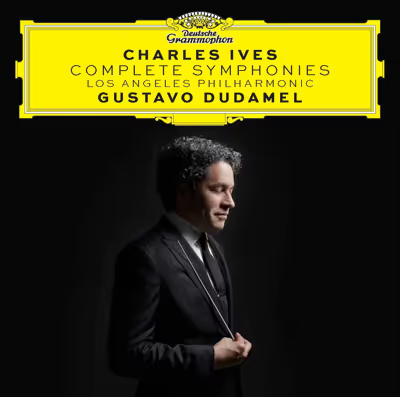
This vibrant collection includes:
- Symphony No. 1, written between 1898 and 1908 but not performed complete until 1953,
- Symphony No. 2, written as a five-movement work c.1907–09 with later revisions, underlining Ives’ maverick status with its ultra-progressive combination of European classical and American popular influences,
- Symphony No. 3 "The Camp Meeting," the Pulitzer Prize-winning composition (1947) written between 1908 and 1911, noted for its nostalgic reflections on the hymns, marches and campfire tunes of the composer’s New England childhood, and
- Symphony No. 4, written c.1912–18 with later revisions and premiered in 1965, more than a decade after the composer’s death — a benchmark of musical invention, ingenuity and ambition.
Track Listing
Symphony No. 1
- I. Allegro con moto
- II. Adagio molto. Sostenuto
- Scherzo. Vivace
- Allegro molto
Symphony No. 2
- I. Andante moderato
- II. Allegro
- III. Adagio cantabile
- IV. Lento maestoso
- V. Allegro molto vivace
Symphony No. 3 “The Camp Meeting”
- I. Old Folks Gatherin’ - Andante maestoso
- II. Children's Day - Allegro moderato
- III. Communion - Largo
Symphony No. 4
- I. Prelude. Maestoso
- II. Comedy. Allegretto
- III. Fugue. Andante moderato
- IV. Finale. Very slowly - Largo maestoso


.jpg?w=350&h=292&f=cover&fx=50&fy=50)
About the Composer:
Charles Ives was born in 1874 in Danbury, Connecticut. His father was the youngest bandmaster in the Union Army during the American Civil War and encouraged his son to make music. Young Ives also excelled at baseball and American football. He received a solid grounding in harmony and counterpoint from his composition professor at Yale University, and ran experiments in mixing different types of music with the Hyperion Theater Orchestra. Ives made his living in the insurance business and composed in his spare time, a practical arrangement that delivered great creative freedom. This staunchly independent thinker synthesized the American folk tunes and hymns of his childhood with his own aesthetic, using techniques such as bitonality and polyrhythms decades before they entered the standard 20th-century composition toolbox to create a unique sound and a personal voice – truly, an American original.

