Villa-Lobos & Stravinsky: Pájaros Mágicos
Released on March 20, 2026
- Now available on all streaming services.
- Recorded live at Walt Disney Concert Hall in October 2023.
This new album from the Los Angeles Philharmonic and Music & Artistic Director Gustavo Dudamel brings together two early-20th-century ballets inspired by mythical birds: Igor Stravinsky’s The Firebird and Heitor Villa-Lobos’s Uirapuru. Written within a decade of each other, both works use folklore and avian myth to explore enchantment, transformation, and the thin margin between the natural and the supernatural.
Listen to Pájaros Mágicos:
Apple Music | Amazon Music | Spotify | Idagio | Tidal | YouTube Music | Deezer
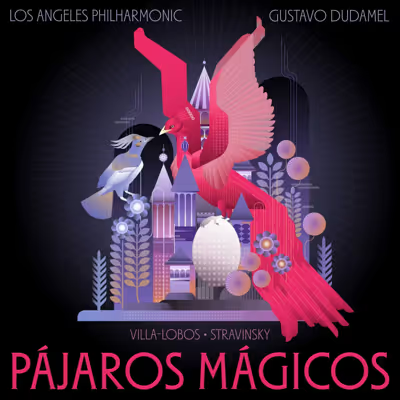
Igor Stravinsky wrote The Firebird in 1910 for Sergei Diaghilev and his company, Ballets Russes, completing the score in just six months. The 1919 suite performed here distills the ballet’s dramatic arc from its shadowy opening, through the explosive Infernal Dance, to a radiant, triumphant finale often considered one of the most exultant endings in all of orchestral music. The work has remained a cornerstone of orchestral repertoire, especially in Los Angeles, where Stravinsky himself conducted it at the Hollywood Bowl in 1940.
Seven years after Stravinsky forged his fabled fire creature, Villa-Lobos began writing Uirapuru in Brazil, drawing on legends surrounding a small Amazonian bird believed to possess magical powers. The composition evolved over many years before reaching its final form in 1935. The music reflects Villa-Lobos’s experiences in the Amazon, punctuated with prominent bird calls, distinctive percussion, and Brazilian melody. The ballet’s story moves between violence and transformation before reaching its subdued conclusion, representing the restoration of balance in nature.
Conductor Gustavo Dudamel says, “The magical birds of The Firebird and Uirapuru have lived with me for many years. In Stravinsky’s 1919 suite, you feel an extraordinary balance between the raw energy that changed the course of music history and moments of incredible delicacy and beauty. Villa-Lobos’ music is born from the land, from the sounds of the forest, from myth, from the spirit of Brazil. In Uirapuru, the orchestra becomes nature itself: a living ecosystem of sound and texture. When you bring these two works together, something very powerful happens. Both works speak to myth, ritual, and transformation. I love this pairing because it creates a conversation between cultures, between the natural world and folklore, and between ancient stories and a musical language that continues to feel vibrant today.”
Written by near-contemporaries, the scores of Igor Stravinsky and Heitor Villa-Lobos offer two distinct visions of musical enchantment; one glows with orchestral brilliance and mythic spectacle while the other roots itself in the living world, drawing from the sounds and folklore of the forest. More than a century later, both works continue to reveal new truths about transformation, nature, and the unseen forces that shape human storytelling.
Track Listing
1. VILLA-LOBOS Uirapuru
STRAVINSKY The Firebird Suite (1919 version)
2. I. Introduction
3. II. Dance of the Firebird
4. III. Dance of the Princesses
5. IV. Infernal Dance of King Kastchei
6. V. Berceuse
7. VI. Finale

