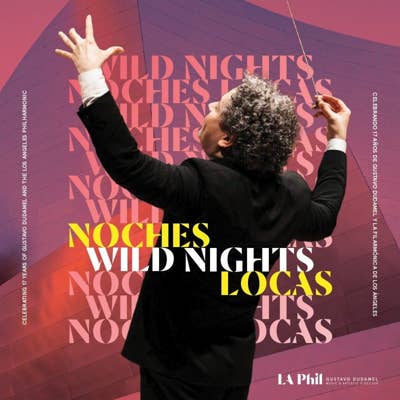
Wild Nights / Noches Locas: Celebrating 17 Years of Gustavo Dudamel and the Los Angeles Philharmonic
- Exclusive limited-edition vinyl!
- Recorded live at Walt Disney Concert Hall, June 4–7, 2026.
- Now available for pre-order!
Recorded live at Walt Disney Concert Hall from June 4 to 7, 2026, and sold exclusively at the LA Phil Store, Wild Nights / Noches Locas: Celebrating 17 Years of Gustavo Dudamel and the Los Angeles Philharmonic features the orchestra alongside tenor Anthony León, baritone Eleomar Cuello, and the Los Angeles Master Chorale performing two landmark works—John Adams’ Harmonium and Antonio Estévez’s Cantata Criolla—under Dudamel’s baton to celebrate his exceptional journey as the LA Phil’s Music & Artistic Director.
Wild Nights / Noches Locas: Celebrating 17 Years of Gustavo Dudamel and the Los Angeles Philharmonic is now available for pre-order at these destinations:
Track Listing
DISC ONE, SIDE A
1. Gabriela ORTIZ Mujer Arena
John ADAMS Harmonium
2. I. Negative Love
DISC ONE, SIDE B
John ADAMS Harmonium (cont.)
3. II. Because I Could Not Stop for Death
4. III. Wild Nights
DISC TWO, SIDE C
ESTÉVEZ Cantata Criolla
5. I. Lento e Cadencioso
DISC TWO, SIDE D
ESTÉVEZ Cantata Criolla (cont.)
6. II. Lento, Tenebroso
7. III. La Porfía (The Duel)
Preview
3 Images
%20Large.png?w=1500)
%20Large.png?w=1500)
%20Large.png?w=1500)


About the Composers:
Composer, conductor, and creative thinker—John Adams occupies a unique position in the world of music. His works stand out among contemporary classical compositions for their depth of expression, brilliance of sound, and the profoundly humanist nature of their themes. His operas and oratorios such as Nixon in China, Doctor Atomic, and El Niño have transformed the genre of contemporary music theater. Spanning five decades, works such as Harmonielehre, Shaker Loops, The Dharma at Big Sur, and his Violin Concerto are among the most performed of all contemporary classical music.
An accomplished woodwind player, Estévez studied oboe and composition in Caracas and played oboe in the Venezuela Symphony Orchestra. He studied in the United States with Leonard Bernstein and others at Columbia and Tanglewood for four years. After returning to Venezuela he wrote his nationalistic masterpiece, the Cantata Criolla. His music subsequently took a much more modernist direction, and he studied electronic music in Paris. He founded the Studio de Fonología Musical in Caracas and composed an electronic environmental piece for the Venezuela Pavilion at the Montreal World’s Fair.
Born to a musical family in Mexico City, Gabriela Ortiz has always felt she didn’t choose music—music chose her. Her parents were founding members of Los Folkloristas, a renowned ensemble dedicated to performing Latin American folk music. While playing charango and guitar with her parents’ group, she was also learning classical piano. Her formal studies began under esteemed Mexican composers Mario Lavista, Federico Ibarra, and Daniel Catán. Later, she continued her studies in Europe, earning a Master’s degree at Guildhall School of Music and Drama, under the guidance of Robert Saxton, and earning a doctorate in composition and electronic music from London’s City University, under the guidance of Simon Emmerson.
Ortiz’s music incorporates seemingly disparate musical worlds, from traditional and popular idioms to avant-garde techniques and multimedia works. This is, perhaps, the most salient characteristic of her oeuvre: an ingenious merging of distinct sonic worlds. While Ortiz continues to draw inspiration from Mexican subjects, she is interested in composing music that speaks to international audiences.