Seasons of America with Teddy Abrams & Ray Chen
October 29, 2026
A SHORT PIECE FOR ORCHESTRA
Julia Perry (1924–79)
Composed: 1952
Orchestration: piccolo, 2 flutes, 2 oboes, English horn, 2 clarinets, bass clarinet, 2 bassoons, contrabassoon, 4 horns, 3 trumpets, 2 trombones, tuba, timpani, percussion (xylophone, cymbals, snare drum, bass drum), harp, piano (=celesta), and strings
First LA Phil performance: September 11, 2018, Karina Canellakis conducting
An African American composer and conductor born in Kentucky, Julia Perry studied at Westminster Choir College and then Juilliard. Many of her early works are vocal, often incorporating influences from Black spirituals. She also studied with Luigi Dallapiccola at Tanglewood and in Italy, and she worked with Nadia Boulanger, winning the Boulanger Grand Prix for her Viola Sonata. Her catalog includes a dozen symphonies and a pair of piano concertos; her theater works include three operas and a ballet, several incorporating her own librettos or scenarios.
Recent efforts to republish many of Perry’s works have fueled a revived interest in her music, but her Short Piece for Orchestra (also known as Study for Orchestra, 1952), which was recorded in a live performance by the New York Philharmonic under William Steinberg in 1965, remains her most frequently performed piece. It is an initially raucous, highly energized essay, brilliantly scored. There are edgy lyrical contrasts, however, and the work closes in a haunted lento, before a whiplash ending returns the aggressive opening thunder. — John Henken
SEASONS OF AMERICA
Teddy Abrams (b. 1987)
Composed: 2026
Orchestration: flute (=piccolo), oboe, clarinet, bassoon, horn, trumpet, trombone, percussion (vibraphone, xylophone, chimes, gongs, cymbals, mark tree, snare drum, triangle, almglocken, tom-toms, glockenspiel, bass drum), harp, strings, and solo violin
First LA Phil performances.
As a conductor and composer, Teddy Abrams embraces big ideas: ideas that trace musical history, give context to a sense of place, and resonate within greater societal progression. His 2021 Piano Concerto, written for Yuja Wang, was conceived as a companion piece to Gershwin’s Rhapsody in Blue but evolved into an 11-part exploration of more than a century of American music. Two years later, his 90-minute oratorio for solo cello, baritone, choir, and orchestra, Mammoth, recounted 5,000 years of human activity at Kentucky’s Mammoth Cave National Park and was premiered in the actual cave.
In his new concerto, Seasons of America, written for violinist Ray Chen, Abrams continues to sink his teeth into meaty themes and pertinent topics, starting with the two invoked in the title. “Seasons” refers to the work’s musical predecessor: Vivaldi’s 1725 masterpiece, The Four Seasons, a quartet of violin concertos that render annual observations such as birdsong, barking dogs, thunderstorms, hunting calls, and snowfall within an annual framework—a revolutionary concept at its time. Chen initially approached Abrams with the idea for a contemporary Four Seasons—one that felt relevant to our current era and would be embraced by fellow violinists. Whereas Vivaldi’s Seasons are a compilation of four separate concertos, Abrams’ cycles through a single four-movement work.
The second half of the title defines its geographical scope. As the premiere would coincided with the 250th anniversary of the United States, the form of a Four Seasons rooted in the American landscape started to take shape. Abrams took “a postcard-type of approach” and began attaching specific places to each season. “Spring,” naturally, was placed in the Appalachian Mountains, not just in a nod to Aaron Copland but due to its proximity to Abrams’ primary home in Louisville, KY. “Summer” summons Southern California beaches, “Fall” depicts the colorful foliage of the Northeast, and “Winter” outlines the rugged terrain of the Rocky Mountains and Alaska. The last movement brings about a “Recursion” announcing the arrival, once again, of Spring.
Linking together these picturesque soundscapes, Abrams charts the evolution of the country itself across movements. “The bigger story of the piece has become a question of the psychological seasons of the country, thinking about it in terms of the seasons of personhood,” Abrams says. He opens with “the hope and promise of a young country finding its way through the heat and cooling of literal climates, but also a country that has been through turmoil, tragedy, and questioning, and ultimately finding renewal and hope. As spring returns we contemplate this cycle of 250 years.” As with the Piano Concerto, Abrams paves this journey with snippets of American vernacular music, weaving together a meta-narrative along the way.
The first movement, “Spring,” bursts forth in a cascade of descending 16th notes made lightning quick by a brisk vivace tempo. The score is marked “baroque,” harking back to the 18th century, the time of both Vivaldi and the founding of the United States. While Copland’s Appalachian Spring doesn’t appear, about halfway through a jaunty fiddle tune surfaces in the solo line and is repeated in the strings. This is a reference to “Bonaparte’s Retreat,” the folk tune famously performed by Kentuckian William Hamilton Stepp, recorded by Alan Lomax, and referenced in Copland’s “Hoedown” from the ballet Rodeo.
“Summer” opens on a rocking motif bowed by the cellos and violas. Here, Abrams calls for a “floating” sensation as he imagines a peaceful Santa Monica beach, punctuated with glimmers of stardust from woodwinds, harp, and glockenspiel. Amid this languorous scene, the soloist enters with a cinematic flourish marked “appassionato,” setting up a juxtaposition between calm waters and a dramatic theme worthy of a big-budget studio film.
Says Abrams: “I was really interested in this idea of old Hollywood meets the ocean, where you have this laid-back feeling—the warmth of the sun, the coolness of the breeze, and the repetition of the waves—and then mixing it with Korngold and the Hollywood Golden Age composers.”
Autumn leaves dance in the breeze in the beginning of “Fall,” structured as a third-movement scherzo and in triple meter. “It has an almost carefree, windswept feel to it, and then it also contains the knowledge that things are turning,” Abrams explains. A slower middle section is colored with the tinge of unease and recognition of mortality that accompanies aging. The movement ends existentially with a set of variations based on the “endless melody” that provides the foundation for Charles Ives’ The Unanswered Question.
“Winter” starts austerely, “and then it flips back and forth between that kind of coldness of winter and the warmth of old-fashioned homestead,” Abrams says. In an Ivesian stroke, Abrams calls for the string players to independently choose from American hymns and folk songs and play them at their own pace, as if they are “gentle prayers and murmurings.” This chorale brings winter to a close and ushers in the return of spring—a final fantasia on the initial theme and the promise of renewal. — A.A.
THREE PLACES IN NEW ENGLAND, S. 7
Charles Ives (1874–1954)
Composed: 1914; 1929
Orchestration: 3 flutes (3rd=piccolo), 2 oboes (2nd=English horn), 2 clarinets, 2 bassoons, contrabassoon, 4 horns, 2 trumpets, 3 trombones, tuba, timpani, percussion (bass drum, snare drum, cymbals, gong), 2 harps, celesta (=piano), organ, and strings
First LA Phil performance: December 29, 1932, Nicolas Slonimsky conducting
Light reflects off a bronze statue at the edge of Boston Common and into Charles Ives’ first movement from Three Places in New England. Colonel Robert Gould Shaw was a Union officer who marched a unit of Black volunteer soldiers into a massacre at Fort Wagner near Charleston, SC. The colonel’s parents commissioned sculptor Augustus Saint-Gaudens to commemorate their son, and he responded with an image of heroism embossed onto a slab of sad fate. Ives spent many childhood days in the Common near the relief, and his “St. Gaudens” movement conjures his impression of Shaw and his men walking into death. The composer’s penchant for interweaving familiar melodies is used here to evoke the dissipating echoes of two Civil War songs, “The Battle Cry of Freedom” and “Marching Through Georgia,” which he surrounds with cannon smoke and confusion. A soldierly horn occasionally pierces through the din, and there is a brief brass attempt at a rally, but all notes of courage are felled.
In the second movement, “Putnam’s Camp, Redding, Connecticut,” Ives visits another place of meaning to him—a few miles from where he was born—and the site of another American war. Partly in response to the death of his uncle Lyman Brewster, who wanted Ives to compose an opera based on his play about Major John André (a traitorous British spy in the Revolutionary War), the composer wrote a chamber piece, 1776 Overture and March—a wild, modernist mash-up of the revolutionary songs “Hail, Columbia,” “The Red White and Blue,” and “The British Grenadiers.” (The effect recalls his boyhood experience hearing marching bands in the town square, playing different tunes in surround sound.) He wrote “Country Band March” around the same time and fused the two pieces to form the Putnam movement, creating a fictional story about a boy who falls asleep during a Fourth of July picnic and dreams about a battle waged at the camp.
There is no bloodshed in Ives’ third place, only bliss. “The Housatonic at Stockbridge” is a river where the composer shared a honeymoon walk with his new wife, Harmony, on a Sunday morning in the summer of 1908. “We walked in the meadows along the river, and heard the distant singing from the church across the river,” Ives recounted in his Memos. “The mist had not entirely left the river bed, and the colors, the running water, the banks and elm trees were something that one would always remember.” He set the memory to music, and it nicely bookends this three-part ode to his beloved New England with something of the same dreamy, gauzy quality as the Shaw remembrance...only of a much happier time. — Tim Greiving
AN AMERICAN IN PARIS
George Gershwin (1898–1937)
Composed: 1928
Orchestration: 3 flutes (3rd=piccolo), 2 oboes, English horn, 2 clarinets, bass clarinet, 3 saxophones (alto, tenor, baritone), 2 bassoons, 4 horns, 3 trumpets, 3 trombones, tuba, timpani, percussion (bass drum, bells, cymbals, snare drum, taxi horns, tom-toms, triangle, woodblock, xylophone), celesta, and strings
First LA Phil performance: January 15, 1931, Artur Rodziński conducting
Since his early teens, Gershwin had been enamored with the music he heard uptown in Harlem, a part of Manhattan that was quickly becoming the center of the jazz universe. His first attempt at a more serious composition—the one-act opera Blue Monday—was about characters in a Harlem nightclub. Its first presentation on Broadway, with white singers performing in blackface, was a flop and received only one performance.
The undaunted Gershwin’s next try at a classical/jazz merging was for Paul Whiteman’s “An Experiment in Modern Music” concert in February 1924. That piece is now known as Rhapsody in Blue. He followed this with his Concerto in F, which some writers called “The Jazz Piano Concerto.” These two works were popular, though critics were still guarded with their praise.
A trip abroad inspired Gershwin to work in earnest on a commission he had received from the New York Philharmonic. His idea for the new work solidified as he was shopping for Parisian taxi horns to take back to the US: Capture the tumult of Paris’ streets in music and create a concert work that didn’t center on the piano.
Back in New York, Gershwin finished An American in Paris, which he subtitled “A Tone Poem for Orchestra.” In an interview in the August 18, 1928, edition of Musical America, he said, “This new piece, really a rhapsodic ballet, is written very freely and is the most modern music I have yet attempted.” He also gave a brief program note of the work: “The opening gay section is followed by a rich ‘blues’ with a strong rhythmic undercurrent. Our American…perhaps after strolling into a café and having a few drinks, has suddenly succumbed to a spasm of homesickness. The harmony here is both more intense and simple than in the preceding pages. This ‘blues’ rises to a climax followed by a coda in which the spirit of the music returns to the vivacity and bubbling exuberance of the opening part with its impressions of Paris. Apparently the homesick American, having left the café and reached the open air, has downed his spell of the blues and once again is an alert spectator of Parisian life. At the conclusion, the street noises and French atmosphere are triumphant.”
Though not a critical success, An American in Paris was wildly and widely embraced by audiences—and Hollywood—and established Gershwin as an original voice in concert halls worldwide, a voice that resonates to this day. — Dave Kopplin
Upcoming Events
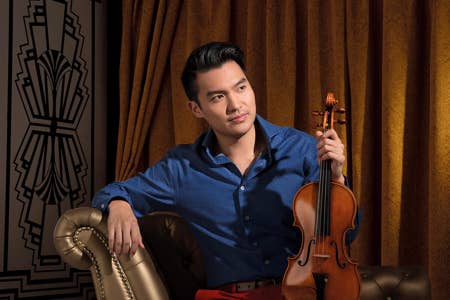
Seasons of America with Teddy Abrams & Ray Chen
Violinist Ray Chen joins conductor/composer Teddy Abrams for a tour of American symphonic music.