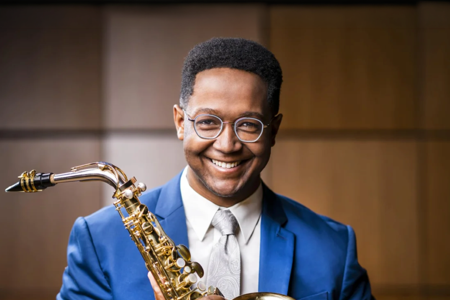
Diaspora: Concerto for Saxophone and Orchestra
Motherland
If We Must Die
And Still I Rise
At a Glance
-
Composed
2023 -
Length
c. 25 minutes -
Orchestration
2 flutes (2nd=piccolo and alto flute), oboe, English horn, 2 clarinets, bassoon, contrabassoon, 3 horns, 2 trumpets, trombone, bass trombone, timpani, percussion (chimes, xylophone, vibraphone, marimba, woodblocks, triangle, brake drum, cowbell, cymbals, tam-tam, tambourine, snare drum, bass drum), harp, piano (=celesta), strings, and solo soprano and alto saxophones
About this Piece
Diaspora: Concerto for Saxophone and Orchestra is a symphonic poem that strives to chronicle the paradigm of the forced black American diaspora, as sifted through the prism of my own experience as a black man in America. When Steven Banks approached me about the piece, the first thing we discussed was the narrative: What particular story would the piece tell? How would it unfold? We decided that, much in the same way that Ravel’s Gaspard de la nuit illustrates three poems by Aloysius Bertrand in three separate movements, so would this concerto do with poems by black poets. But then I started thinking of the elegantly succinct and fluent structure of Barber’s Symphony No. 1, where in one multi-sectioned suite he brilliantly ties together a handful of thematic materials into a seamless and organic whole. So I started to compose from the vantage point that the poems Steven and I settled on (“Africa’s Lament” by Nayyirah Waheed, “If We Must Die” by Claude McKay, and “Still I Rise” by Maya Angelou) would be guideposts that inspired the direction of a three-part storyline: Motherland, If We Must Die, and And Still I Rise. Also, I wanted to tie the piece together thematically with various melodies and motifs treated in different ways (inverted, augmented, contrapuntally treated, reharmonized, etc.), like a loosely structured theme and variations—except there are several themes used.
Movement I: MOTHERLAND
The program of the composition starts out on a positive note; the first theme played solo by the soprano saxophone and later joined by an uplifting scherzo accompaniment from the orchestra is meant to evoke a sense of well-being and security as Africans are living in the motherland (“Motherland” being the name of the first section). Of course, it is understood that within the confines of Africa itself there were tribal wars, treachery, and misery—even slavery; it’s not a utopia I’m trying to illustrate here. Rather, I want to depict a sense of purity—a purity arising from having been thus far unobstructed by the outside destructive forces that would later determine our fate. So the movement starts with a soprano sax melody that begins as a diatonic motif (accompanied by marimba and pizzicato cello), but then quickly becomes chromatic, modulating to several remote tonalities. After this, a 16th-note pattern in the strings transitions the listener into a sense of foreboding, signaling trouble on the horizon. As the harmonies of the string patterns continue to shift toward a more ominous shade, the soprano saxophone takes on a more urgent tone, playing short bursts of melodic fragments. Then a battle ensues, a battle between the slave traders and the future slaves, as signaled by the triplet figures in the soprano sax accompanied by triplet patterns in the orchestra and climaxing in an orchestral tutti section bolstered by a brass fanfare. After a dissonant orchestral hit, the soprano sax utters a melancholy theme as the slaves are being led to the slave ship. This takes us to the first saxophone cadenza, which to my mind represents a moment of painful reflection about being captured like a wild animal and led to a ship, the destination of which is a future hell.
Movement II: IF WE MUST DIE
Part two of the journey (inspired by the powerful Claude McKay poem of the same name) begins with the first vision of the slave ship. This is illustrated by a loud tutti blast in the orchestra, following a slow six-measure buildup. The alto saxophone is now the voice of the piece, introducing a rapid 12-tone theme that turns out to be a constant phrase weaving in and out of the entire piece at various moments (it actually makes its first appearance back in the first part, during the battle between the African natives and the slave traders). The slaves are boarded onto the ships, and the Middle Passage journey to America begins; sweeping rapid scales in the lower strings, woodwinds, and harp describe the back-and-forth movement of the waves. This section develops and reaches a high point with a jarring saxophone multiphonic pair of notes followed by a forearm piano cluster; we now see America for the first time, from the point of view of the slaves. A percussion section and saxophone exchange—followed by an antiphonal, almost pointillistic push and pull between the alto saxophone and the orchestra—aims to represent the confusion, rage, and terror of the slave trade, where families are ripped apart as humans are bought and sold like cattle. The subsequent section is a mournful lament of despair, meant to outline the psychological depression caused by the sheer brutality of this new slavery paradigm. The melodic theme here, played by the alto sax, is in its original version, whereas the melancholy soprano sax theme near the end of the first movement is the inversion of this melody. While this is happening, there is a background pattern played by vibraphone and celesta, which depicts a slow and steady growing anger; this figure gets faster and faster until it overtakes the foreground and brings us into the next scherzo-like section. This section is marked by an interplay between the alto sax and the orchestra and is describing a resistance, anger, and rebellion against being subjected to subhuman treatment over the course of centuries. After the apex of this segment occurs—characterized by five orchestral stabs—the alto saxophone plays a short and tender cadenza, which signifies the resilience of black Americans and the introduction of the idea of self-love, self-worth, and self-determination.
Movement III: AND STILL I RISE
This final section of the concerto/tone poem is about black empowerment. The church has always been a cultural focal point in the black community, a sanctuary providing psychological and emotional relief from the particular hardships of black life in America. It is also a place to worship, pray, and wrestle with the larger spiritual and existential questions that concern all of humankind. And beyond that (or perhaps because of that), the church is historically the central hub of black political and cultural activism in America. This is the ethos that the last section of the concerto is reflecting. This final chapter of the piece starts out with a hymn-like passage, which is actually a variation of the opening folk-like melody at the very beginning of the concerto. It is a plaintive reading orchestrated for just alto saxophone and piano, as though the solo saxophonist were a singer accompanied by a piano during a Sunday church service. Soon the melodic theme in the alto sax is treated with a lush accompaniment reminiscent of the Romantic era, as a healing self-awareness and love becomes more palpable. This is followed by a march-like ostinato, which symbolizes steely determination in the midst of great and formidable obstacles, as the alto sax plays rapidly above the orchestral momentum until we finally reach the victorious fanfare at the conclusion of the piece. Maya Angelou’s shining poem reminds us (and America) that black people cannot and will not be held to a position of second-class citizenship—we will still rise.
—Billy Childs
Upcoming Events