Piano Concerto No. 1 in C major, Op. 15
At a Glance
-
Composed
1798 -
Length
c. 35 minutes -
Orchestration
flute, 2 oboes, 2 clarinets, 2 bassoons, 2 trumpets, 2 horns, timpani, strings, and solo piano -
First Los Angeles Philharmonic Performance
March 18, 1954, Alfred Wallenstein conducting, with Paul Badura-Skoda, soloist
About this Piece
The Piano Concerto No. 1 was actually the second of Beethoven’s mature piano concertos. It was first only in order of publication, evidently because he much preferred it to the earlier Concerto “No. 2.” It is a bigger, grander work in every way. Whereas the earlier concerto was a drawing-room work, done with an orchestra so small that Beethoven could rehearse it in his apartment, the C-major Concerto is public music, written for the concert hall, with as large an orchestra as had ever been used in a piano concerto to that point, complete with horns, trumpets, and timpani, and full of contrasts of loud and soft that are absent from his earlier concerto.
Little is known about its origins; it may have been composed as early as 1795, but the first known performance was in a 1798 concert in Prague, in which Beethoven played both of his first two concertos. Another young pianist-composer, Václav Jan Tomášek, heard the concert and later wrote: “I admired his powerful, brilliant playing, but his frequent daring changes from one melody to another, putting aside the organic, gradual development of ideas, did not escape me. Evils of this nature frequently weaken his greatest compositions, those which sprang from a too exuberant conception. The listener is often rudely awakened.... The singular and original seemed to be his chief aim....”
Tomášek’s comments are a warning to those inclined to consider Beethoven’s early compositions as mere imitations of Mozart or Haydn (as if mimicking them were an easy task). The C-major Concerto was an audacious, challenging work to musicians used to the ordered logic that had governed music for a generation.
In the first movement, after turning a tentative knocking motif into a boldly assertive first subject in C major, Beethoven plays tonal “peekaboo” with the second subject, introducing it in the violins in the unexpected key of E-flat major, then having the winds interrupt and trying again in F minor, and then again in G minor on the way to G major, which was the “correct” key for a second subject. Episodes like this, which expand both the timescale and harmonic structure of the music, raised eyebrows among schooled musicians in the 1790s.
The surprise in the A-flat-major slow movement is the orchestration. Removing the trumpets and drums was standard in concerto middle movements (and trumpets never played in A-flat anyway), but Beethoven also drops the flute and oboes, leaving an orchestra of strings, bassoons, horns, and clarinets. This makes for a subdued, middle-heavy sound and turns the highest wind instrument, the first clarinet, into a soloist.
The rondo finale is light-fingered and whimsical, marked Allegro scherzando to emphasize its playfulness.
—Howard Glass
Upcoming Events
Friday Evenings 2 (FR2)
Simply Beethoven Festival
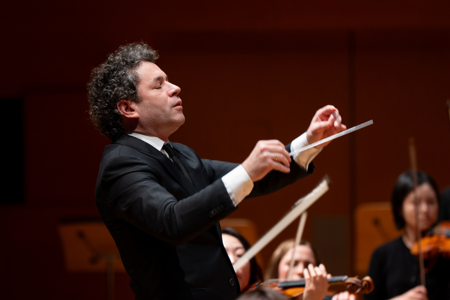
Simply Beethoven: “Eroica” and Piano Concerto No. 1 with Dudamel