Seasons of America
Spring
Summer
Fall
Winter & Recursion
world premiere
LA Phil commission
with generous support from the Lenore S. and Bernard A. Greenberg Fund and the MaddocksBrown Fund for New Music
At a Glance
-
Composed
2026 -
Length
c. 29 minutes -
Orchestration
flute (=piccolo), oboe, clarinet, bassoon, horn, trumpet, trombone, percussion (vibraphone, xylophone, chimes, gongs, cymbals, mark tree, snare drum, triangle, almglocken, tom-toms, glockenspiel, bass drum), harp, strings, and solo violin
About this Piece
As a conductor and composer, Teddy Abrams embraces big ideas: ideas that trace musical history, give context to a sense of place, and resonate within greater societal progression. His 2021 Piano Concerto, written for Yuja Wang, was conceived as a companion piece to Gershwin’s Rhapsody in Blue but evolved into an 11-part exploration of more than a century of American music. Two years later, his 90-minute oratorio for solo cello, baritone, choir, and orchestra, Mammoth, recounted 5,000 years of human activity at Kentucky’s Mammoth Cave National Park and was premiered in the actual cave.
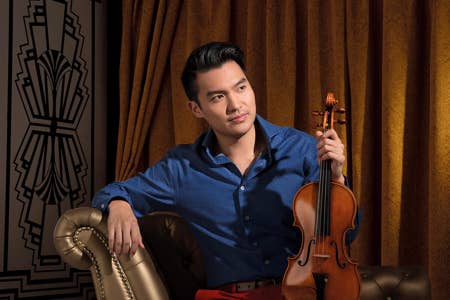
In his new concerto, Seasons of America, written for violinist Ray Chen, Abrams continues to sink his teeth into meaty themes and pertinent topics, starting with the two invoked in the title. “Seasons” refers to the work’s musical predecessor: Vivaldi’s 1725 masterpiece, The Four Seasons, a quartet of violin concertos that render annual observations such as birdsong, barking dogs, thunderstorms, hunting calls, and snowfall within an annual framework—a revolutionary concept at its time. Chen initially approached Abrams with the idea for a contemporary Four Seasons—one that felt relevant to our current era and would be embraced by fellow violinists. Whereas Vivaldi’s Seasons are a compilation of four separate concertos, Abrams’ cycles through a single four-movement work.
The second half of the title defines its geographical scope. As the premiere would coincided with the 250th anniversary of the United States, the form of a Four Seasons rooted in the American landscape started to take shape. Abrams took “a postcard-type of approach” and began attaching specific places to each season. “Spring,” naturally, was placed in the Appalachian Mountains, not just in a nod to Aaron Copland but due to its proximity to Abrams’ primary home in Louisville, KY. “Summer” summons Southern California beaches, “Fall” depicts the colorful foliage of the Northeast, and “Winter” outlines the rugged terrain of the Rocky Mountains and Alaska. The last movement brings about a “Recursion” announcing the arrival, once again, of Spring.
Linking together these picturesque soundscapes, Abrams charts the evolution of the country itself across movements. “The bigger story of the piece has become a question of the psychological seasons of the country, thinking about it in terms of the seasons of personhood,” Abrams says. He opens with “the hope and promise of a young country finding its way through the heat and cooling of literal climates, but also a country that has been through turmoil, tragedy, and questioning, and ultimately finding renewal and hope. As spring returns we contemplate this cycle of 250 years.” As with the Piano Concerto, Abrams paves this journey with snippets of American vernacular music, weaving together a meta-narrative along the way.
The first movement, “Spring,” bursts forth in a cascade of descending 16th notes made lightning quick by a brisk vivace tempo. The score is marked “baroque,” harking back to the 18th century, the time of both Vivaldi and the founding of the United States. While Copland’s Appalachian Spring doesn’t appear, about halfway through a jaunty fiddle tune surfaces in the solo line and is repeated in the strings. This is a reference to “Bonaparte’s Retreat,” the folk tune famously performed by Kentuckian William Hamilton Stepp, recorded by Alan Lomax, and referenced in Copland’s “Hoedown” from the ballet Rodeo.
“Summer” opens on a rocking motif bowed by the cellos and violas. Here, Abrams calls for a “floating” sensation as he imagines a peaceful Santa Monica beach, punctuated with glimmers of stardust from woodwinds, harp, and glockenspiel. Amid this languorous scene, the soloist enters with a cinematic flourish marked “appassionato,” setting up a juxtaposition between calm waters and a dramatic theme worthy of a big-budget studio film.
Says Abrams: “I was really interested in this idea of old Hollywood meets the ocean, where you have this laid-back feeling—the warmth of the sun, the coolness of the breeze, and the repetition of the waves—and then mixing it with Korngold and the Hollywood Golden Age composers.”
Autumn leaves dance in the breeze in the beginning of “Fall,” structured as a third-movement scherzo and in triple meter. “It has an almost carefree, windswept feel to it, and then it also contains the knowledge that things are turning,” Abrams explains. A slower middle section is colored with the tinge of unease and recognition of mortality that accompanies aging. The movement ends existentially with a set of variations based on the “endless melody” that provides the foundation for Charles Ives’ The Unanswered Question.
“Winter” starts austerely, “and then it flips back and forth between that kind of coldness of winter and the warmth of old-fashioned homestead,” Abrams says. In an Ivesian stroke, Abrams calls for the string players to independently choose from American hymns and folk songs and play them at their own pace, as if they are “gentle prayers and murmurings.” This chorale brings winter to a close and ushers in the return of spring—a final fantasia on the initial theme and the promise of renewal.
— Amanda Angel